
© Ansterra Pty Ltd. The content in this learning series, including this article, is copyrighted to Ansterra Pty Ltd. Copying, reproducing, redistributing, or regenerating this content for any commercial purpose without explicit written permission violates copyright and is not permitted.
If you’re searching for selective test preparation resources, you’ve probably noticed there’s no single official syllabus for the NSW Selective High School Placement Test. Instead, the test draws on a wide range of skills built up over years of schooling. That can make knowing where to start feel overwhelming for both students and parents.
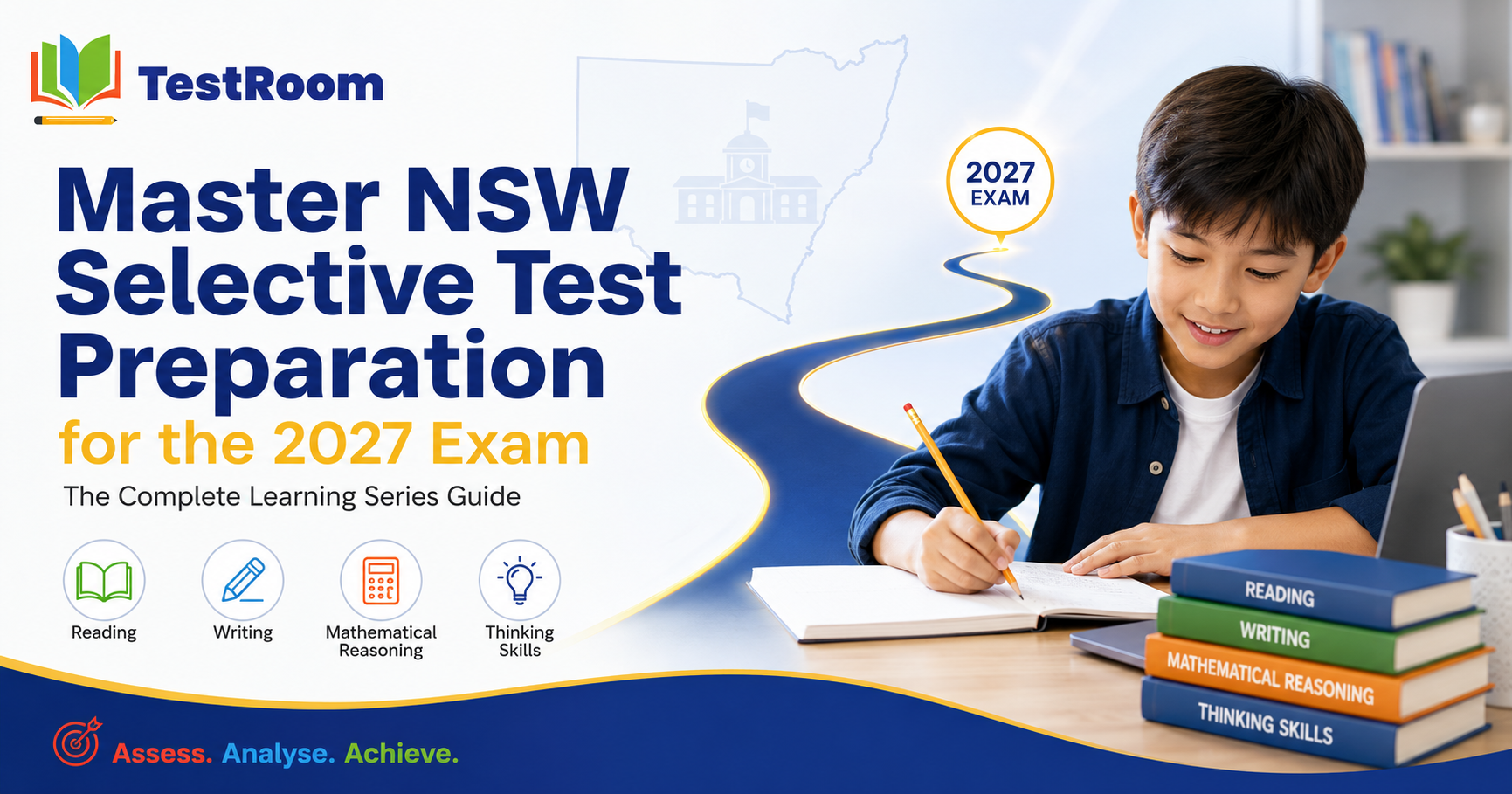
This guide is the starting point for TestRoom’s Selective Test learning series — a structured set of concept guides covering all four sections of the test: Thinking Skills, Mathematical Reasoning, Reading, and Writing. Think of this post as the map. Each section below introduces what that part of the test involves and previews the key concepts the series will explore in depth, before you move on to selective practice tests, selective sample tests, and an online selective practice test for each topic.
It’s also worth noting that most of the concepts covered in this series aren’t just exam-specific — they overlap with what students go on to study in high school across Mathematics, Reading, Writing, and parts of Thinking Skills. That means this learning series does double duty: it helps your child prepare for the Selective Test today, while also building a strong foundation for their high school years ahead.
Because there’s no fixed syllabus for the Selective Test, every concept guide in this series is built directly from analysis of real past papers — identifying the kinds of questions that actually appear, not a hypothetical checklist. This guide will keep growing as new concept guides are published.
What Is the NSW Selective High School Placement Test?
The NSW Selective High School Placement Test is sat by Year 6 students applying for a place in a selective high school for Year 7. It’s a timed, exam-style assessment designed to measure a student’s reasoning, comprehension, and written expression — rather than testing recall of specific classroom content. That’s precisely why generic revision often falls short, and why targeted selective exam preparation matters: students benefit far more from practising the actual question types and reasoning patterns the test uses.
The test is made up of four components, summarised below.
| Test Component | What It Measures | Question Style |
|---|---|---|
| Thinking Skills | Verbal, numerical, and abstract/spatial reasoning | Multiple choice |
| Mathematical Reasoning | Applying maths concepts to multi-step, worded problems | Multiple choice |
| Reading | Comprehension, inference, and analysis of varied texts | Multiple choice |
| Writing | Planning and producing a piece of writing within a time limit | Extended written response |
Note: always check the current test structure, timing, and scoring weightings against the official NSW Department of Education resources, as these details can be updated from year to year.
Why a Learning Series, Not a Single Cram Guide
Most search results for selective practice test resources are just lists of questions with answers — useful for practice, but not for understanding why an answer is correct or how to approach a topic students haven’t seen before. TestRoom’s approach is different: each concept guide in this series builds a topic from first principles up through increasingly challenging question styles, so a student develops genuine understanding rather than memorising one paper’s worth of questions.
As each guide is published, it will be linked from the relevant section below — so this page will become a single, growing hub for the entire Selective Test learning series.
Thinking Skills: Key Concepts in This Series
Thinking Skills is often the section students find hardest to prepare for, simply because it isn’t taught explicitly at school. It covers verbal reasoning (working with words, logic, and arguments), numerical reasoning (spotting patterns and relationships in numbers), and abstract or spatial reasoning (working with shapes, sequences, and visual patterns).
Concepts this series will cover include — among a wide range of other question types:
Topic concepts loading soon…
Concept guides for Thinking Skills are in development and will be linked here as they’re published.
Mathematical Reasoning: Key Concepts in This Series
Mathematical Reasoning goes beyond standard classroom maths — it tests whether a student can apply mathematical concepts to unfamiliar, multi-step, worded problems under time pressure. Our first published concept guide in this strand covers Clocks, a topic that recurs across past papers in a range of forms.
Concepts this series will cover include — among a wide range of other question types:
- Clocks, time intervals, and elapsed time
- More topics loading soon….
Further Mathematical Reasoning concept guides will be linked here as they’re published.
Reading: Key Concepts in This Series
The Reading component tests how well a student can understand, interpret, and analyse a range of text types — from narrative fiction to informational and persuasive texts — often within a tight time limit. It rewards careful, active reading rather than speed alone.
Concepts this series will cover include — among a wide range of other question types:
Topic concepts loading soon…
Concept guides for Reading are in development and will be linked here as they’re published.
Writing: Key Concepts in This Series
The Writing component asks students to plan and produce a piece of writing — often narrative or persuasive — within a strict time limit. Strong performance depends on a clear structure, an engaging voice, and the ability to plan quickly under pressure.
Concepts this series will cover include — among a wide range of other question types:
Topic concepts loading soon…
Concept guides for Writing are in development and will be linked here as they’re published.
How to Use This Learning Series
For best results, treat this page as your starting checkpoint rather than something to read once. A simple approach:
- Start with the subject your child finds most unfamiliar — Thinking Skills is a common starting point, since it’s rarely taught at school.
- Work through concept guides from fundamentals to more advanced material, rather than jumping straight to the hardest questions.
- Pair each concept guide with an online selective practice test or selective mock test to apply what’s been learned under timed conditions.
- Revisit this hub periodically — new concept guides are added as the series grows.
Frequently Asked Questions
What’s the difference between the Selective Test and the OC Test?
The Selective Test is sat in Year 6 for entry into a selective high school in Year 7, while the Opportunity Class (OC) Test is sat in Year 4 for entry into an OC class in Year 5. Both assess similar reasoning skills, but at different stages of primary schooling and with different content emphasis.
When should my child start preparing for the Selective Test?
Many families begin building familiarity with Thinking Skills and Mathematical Reasoning question types from Year 5, gradually increasing the difficulty and pace of practice as the test approaches. There’s no single “right” time to start — consistent, well-structured practice tends to matter more than an early start alone.
Are there free selective practice tests online?
Yes — TestRoom offers a free trial that includes sample questions and an online selective practice test experience, so families can explore the format before committing to a full preparation program.
How many practice tests should a student complete before sitting the real test?
Rather than focusing on a specific number, it’s more effective to use a selective trial test online regularly throughout preparation, reviewing mistakes carefully each time, so practice builds understanding rather than just repetition.
Does this series cover real past paper questions?
No — to respect copyright, this series never reproduces real past paper questions directly. Instead, every concept guide is built from careful analysis of real past papers, with original questions of equivalent style and difficulty created for practice.
Start Practising Today
Whether you’re looking for a selective trial test online, a selective schools practice test, or simply a clear starting point for selective exam preparation, this learning series is designed to grow with your child’s preparation journey. Explore the concept guides above as they’re published, and try a free online selective practice test to see where your child is starting from.
Start your free TestRoom trial →