
Clocks: The Complete OC & Selective Test Concept Guide
Master time questions for NSW OC and Selective Tests with our comprehensive guide on Mathematical Reasoning and Thinking Skills.
By TestRoom · · 26 min read
Time questions appear in almost every NSW OC Test and Selective High School Test paper — across both Mathematical Reasoning and Thinking Skills. But the types of clock problems change significantly as you move from OC to Selective level, and students who prepare for only one style are often caught out by the other.
This guide covers every major Clocks question type identified from NSW exam papers, built from fundamentals up to the most advanced concepts tested at Selective level. Each concept includes a clear explanation, a worked example, common mistakes to watch for, and an original practice question with a full solution.
Whether your child is preparing for the OC Test (Year 4), the Selective Test (Year 6), or working through the topic well in advance, this guide gives them everything they need in one place.
Who this guide is for: Students in Grades 4–7 preparing for the NSW Opportunity Class Placement Test or the NSW Selective High School Placement Test. Concepts are grouped by difficulty — Foundation, Intermediate, and Advanced — so students can work through from the beginning or jump to the level they need.
What the Clocks Topic Actually Covers
Clocks is broader than it first appears. At foundation level it begins with reading analogue and digital clock faces and converting between 12-hour and 24-hour time. By intermediate level it involves adding large numbers of minutes to a time, reasoning backwards from an endpoint, reading multi-column timetables, calculating scheduling capacity, and applying speed ratios. At advanced Selective level it extends into the geometry of the clock face — calculating the angle between the two hands at any given moment, and finding the exact time when the hands coincide or form a specific angle.
The table below shows the full scope of this guide at a glance.
| Concept | Key rule or method | Level | Test section |
|---|---|---|---|
| Reading the clock | Minute gap × 5; pm → 24hr: add 12 | Foundation | Both |
| Elapsed time | Bridge method: count to next hour, then remaining | Foundation | Both |
| Converting minutes to hours | Total ÷ 60 = hours remainder minutes | Foundation | Both |
| Reading timetables | Identify row and column; calculate each journey time | Foundation | Both |
| Adding large minutes | Divide first → add hours → add remainder | Intermediate | Maths |
| Working backwards | Start = End − Duration; borrow 60 if needed | Intermediate | Both |
| Scheduling and capacity | Subtract breaks first, then divide, then multiply by resources | Intermediate | Thinking Skills |
| Speed ratios and time | n× faster → time ÷ n (inverse relationship) | Intermediate | Thinking Skills |
| Overnight and multi-day time | Bridge through midnight; 1 day = 1,440 minutes | Intermediate | Both |
| Clock hand angles | Hour hand: 0.5°/min · Minute hand: 6°/min | Advanced | Maths |
| Hands meeting and overtaking | Gain rate = 5.5°/min; time to gain θ° = θ ÷ 5.5 | Advanced | Maths |
| Multi-variable scheduling | Calculate each resource independently, then combine | Advanced | Thinking Skills |
Foundation Concepts: OC Focus
1. Reading the Clock
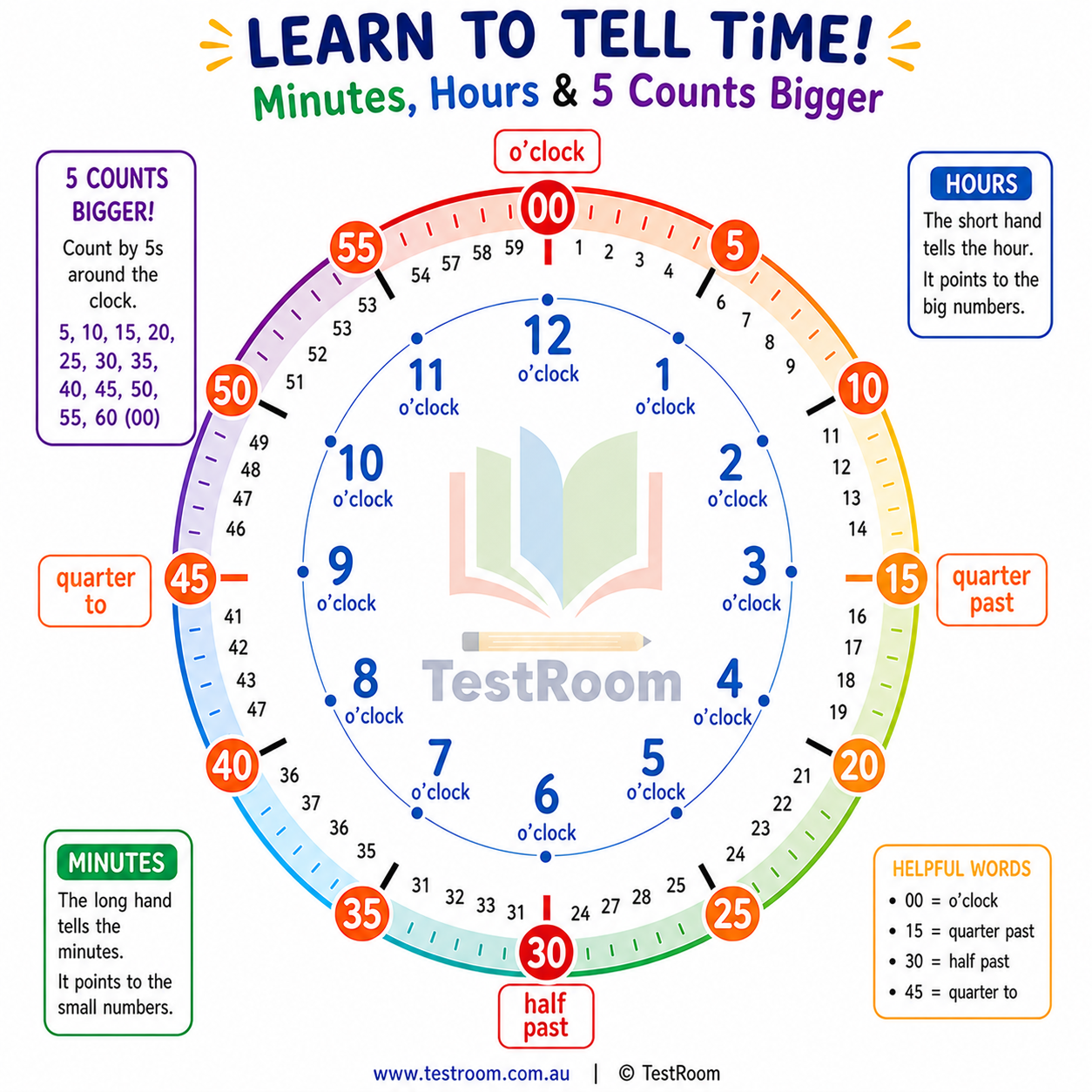
Before any calculation is possible, students need complete fluency with both analogue and digital clock faces, and instant confidence converting between 12-hour and 24-hour time. This sounds basic — but small gaps here create errors all the way up the topic.
Core facts to know:
- The short hand is the hour hand. The long hand is the minute hand.
- There are 12 gaps on a clock face. Each gap equals 5 minutes (60 ÷ 12 = 5). So if the minute hand points to the 7, it means 35 minutes past the hour.
- am runs from midnight to noon. pm runs from noon to midnight.
- To convert a pm time to 24-hour format, add 12 to the hour. So 3:45 pm becomes 15:45. The one exception is 12:xx pm — noon times stay as 12 (12:30 pm = 12:30, not 24:30).
- To convert a 24-hour time back to 12-hour, subtract 12 from any hour above 12 and label it pm.
- Midnight = 00:00 or 12:00 am. Noon = 12:00 or 12:00 pm.
Common mistake: Students often convert 14:45 as “4:45” by subtracting 10 instead of 12. Always subtract 12 from the full hour digit. 14 − 12 = 2, so 14:45 = 2:45 pm.
Practice question (OC level): A digital clock displays 14:45. A student says this is “quarter to 3 in the afternoon.” Is the student correct?
A. Yes — 14:45 converts to 2:45 pm, which is quarter to 3
B. No — 14:45 is 2:45 am, not pm
C. No — 14:45 is quarter past 2, not quarter to 3
D. No — 14 hours cannot be converted to a pm time
Answer: A. 14:45 in 24-hour time: 14 − 12 = 2, so the time is 2:45 pm. 2:45 pm is 15 minutes before 3:00 pm — which is exactly what “quarter to 3 in the afternoon” means. The student is correct.
2. Elapsed Time
Elapsed time is the duration between a start time and an end time. This concept underpins every other question type in the Clocks topic — scheduling, working backwards, speed ratios — so getting it right every time matters.
The most reliable method is the bridge method: rather than subtracting directly (which fails across the hour boundary), count forward in steps.
Bridge method — three steps:
- Count from the start time up to the next whole hour.
- Count the whole hours between that hour and the final hour.
- Count the remaining minutes to reach the end time.
- Add all three amounts.
Example: How long from 8:40 am to 11:15 am?
- 8:40 → 9:00 = 20 minutes
- 9:00 → 11:00 = 120 minutes
- 11:00 → 11:15 = 15 minutes
- Total = 20 + 120 + 15 = 155 minutes (2 hours 35 minutes)
Crossing noon: When a time span crosses from am to pm, use noon (12:00) as the bridge point, not the next hour. Count from the start time to noon, then from noon to the end time.
Practice question (OC level): A school excursion departs at 8:35 am and returns at 2:10 pm. How long does the excursion last?
A. 5 hours 25 minutes
B. 5 hours 35 minutes
C. 6 hours 25 minutes
D. 5 hours 45 minutes
Answer: B. Using the bridge method: 8:35 → 9:00 = 25 minutes. 9:00 → 2:00 pm = 5 hours = 300 minutes. 2:00 pm → 2:10 pm = 10 minutes. Total = 25 + 300 + 10 = 335 minutes = 5 hours 35 minutes.
3. Converting Minutes to Hours
Many exam questions give a total number of minutes — often between 100 and 600 — and ask you to work with that amount. Before you can add or subtract it cleanly, you need to express it as hours and minutes. The tool is short division by 60.
Method:
- Divide total minutes by 60.
- The quotient (whole number result) is the hours.
- The remainder is the extra minutes.
- Verify: hours × 60 + remainder should equal the original total.
Example: Convert 430 minutes.
430 ÷ 60: 7 × 60 = 420, remainder = 430 − 420 = 10.
So 430 minutes = 7 hours 10 minutes. Check: 7 × 60 + 10 = 430 ✓
Common mistake: Rushing the remainder. For 430 ÷ 60, students sometimes write remainder 30 (confusing 7 × 60 = 420 with 7 × 60 = 400). Always write out the multiplication explicitly.
Practice question (OC level): A factory machine runs for 375 minutes without stopping. How long is that in hours and minutes?
A. 5 hours 45 minutes
B. 6 hours 5 minutes
C. 6 hours 15 minutes
D. 6 hours 25 minutes
Answer: C. 375 ÷ 60: 6 × 60 = 360, remainder = 375 − 360 = 15. So 375 minutes = 6 hours 15 minutes.
4. Reading Timetables
Timetable questions appear regularly in both OC and Selective tests. Rather than a simple clock, you are given a grid of times across multiple services and asked to find the fastest option, calculate a connection time, or identify how long a specific leg takes.
Strategy for timetable questions:
- Read the question carefully before looking at the table — identify exactly which row, which column, and which direction you need.
- To find the fastest service, calculate the duration of each option rather than just comparing departure times.
- Connection time = departure time of the second service minus arrival time of the first service. If this is negative, the connection is missed.
- Timetable times are almost always in 24-hour format. Translate to 12-hour if it helps you think more clearly.
| Stop | Train A | Train B | Train C | Train D |
|---|---|---|---|---|
| Northgate | 07:10 | 08:25 | 09:40 | 10:55 |
| Riverside | 07:38 | 08:50 | 10:05 | 11:18 |
| Citypark | 08:02 | 09:20 | 10:35 | 11:45 |
| Harbourne | 08:45 | 10:00 | 11:15 | 12:25 |
| Endvale | 09:30 | 10:40 | 11:55 | 13:05 |
Practice question (OC level): Using the timetable above, a passenger arrives at Citypark station at 10:30. They want to reach Harbourne as early as possible. Which train should they catch, and how long will the journey from Citypark to Harbourne take?
A. Train B — 40 minutes
B. Train C — 40 minutes
C. Train C — 45 minutes
D. Train D — 40 minutes
Answer: B. The passenger arrives at 10:30. Train B departs Citypark at 09:20 — already gone. Train C departs Citypark at 10:35, which is the next departure after 10:30. Journey time: 10:35 to 11:15 = 40 minutes. Train C, 40 minutes.
Intermediate Concepts: OC and Early Selective
5. Adding Large Numbers of Minutes to a Time
This is one of the most frequently tested OC Mathematical Reasoning question types. The question gives you a start time and asks what the clock will show after a large number of minutes — typically somewhere between 100 and 600.
Students who try to count minute by minute, or add the minutes directly to the minutes digit on the clock, will always make errors. The correct approach is to convert first.
The type of question you may see in the exam: “A clock shows [time]. What time will it show [large number] minutes later?” with four or five answer options. Expect the options to include answers that result from forgetting to cross noon, miscalculating the remainder, or confusing hours and minutes.
Three-step method:
- Divide the total minutes by 60 to find whole hours (H) and the remainder (R).
- Add H hours to the start time.
- Add R minutes to the result. If the result crosses noon, the am/pm flips.
Worked example: A clock shows 7:20 am. What time will it show 430 minutes later?
- Step 1: 430 ÷ 60 → 7 × 60 = 420, remainder 10 → 7 hours 10 minutes
- Step 2: 7:20 am + 7 hours = 2:20 pm (crosses noon)
- Step 3: 2:20 pm + 10 minutes = 2:30 pm
Common mistakes:
- Forgetting the am to pm flip when the result crosses noon.
- Miscalculating the remainder — always write out the multiplication explicitly (7 × 60 = 420, so remainder = 430 − 420 = 10, not 30).
- Adding the remainder first then the hours — this can create a carry error at the minutes boundary.
Practice question (OC level): A clock shows 6:10 am. What time will it show 500 minutes later?
A. 2:10 pm
B. 2:30 pm
C. 2:50 pm
D. 3:10 pm
E. 2:20 pm
Answer: B. 500 ÷ 60: 8 × 60 = 480, remainder = 500 − 480 = 20 → 8 hours 20 minutes. 6:10 am + 8 hours = 2:10 pm. 2:10 pm + 20 minutes = 2:30 pm.
6. Working Backwards from an End Time
When a question gives you the finishing or arrival time and asks for the start or departure time, you subtract the duration rather than adding it. This pattern appears regularly in OC Thinking Skills, often layered with another concept such as speed ratios.
Rule: Start time = End time − Duration
Convert the duration to hours and minutes before subtracting. If the minutes don’t subtract cleanly, borrow 1 hour (60 minutes) from the hours column.
Worked example: A swimming race finishes at 10:15 am. The winner took 48 minutes. When did the race start?
- 10:15 − 48 minutes: borrow → think of 10:15 as 9 hours 75 minutes
- 75 − 48 = 27 minutes
- Start time: 9:27 am
The type of question you may see in the exam: Two vehicles travel the same route but at different speeds, both arriving at the same time. You are given the arrival time and the duration of one vehicle’s journey, and must find when the other departed. This combines working backwards with speed ratio reasoning.
Practice question (OC level): A bus arrives at its final stop at 3:05 pm. The journey took 1 hour 45 minutes. At what time did the bus depart?
A. 1:10 pm
B. 1:20 pm
C. 1:30 pm
D. 1:50 pm
Answer: B. 3:05 pm − 1 hour = 2:05 pm. 2:05 pm − 45 minutes: borrow → 1 hour 65 minutes − 45 minutes = 1 hour 20 minutes → 1:20 pm.
7. Scheduling and Capacity
Scheduling problems are a defining question type in the OC Thinking Skills section. The question asks how many appointments, sessions, or services can fit into a time window given a fixed slot length, breaks per worker, and a number of parallel resources (people, lanes, rooms, machines).
The type of question you may see in the exam: A workplace, clinic, or facility operates between set hours. Each service takes a fixed number of minutes. Each worker has a break. You are asked for the maximum total number of services across all workers in the day. The answer options include deliberate wrong answers produced by common arithmetic shortcuts.
Four-step framework:
- Total window = Close time − Open time, in minutes.
- Subtract all breaks per resource → available minutes per resource.
- Slots per resource = available minutes ÷ slot length (do not round up — a part slot cannot be used).
- Total capacity = slots per resource × number of resources.
The most important rule: subtract breaks before dividing, never after. Doing it the other way produces the most common wrong answer.
Worked example: A hair salon is open from 9:00 am to 6:00 pm. Each appointment takes 30 minutes. Each stylist has a 60-minute break. Four stylists work in the salon. What is the maximum number of appointments in a day?
- Window: 9:00 am to 6:00 pm = 9 hours = 540 minutes
- Per stylist: 540 − 60 = 480 available minutes
- Slots per stylist: 480 ÷ 30 = 16
- Four stylists: 16 × 4 = 64 appointments
Common mistakes:
- Dividing before subtracting breaks: 540 ÷ 30 × 4 = 72 — this is too high, and is a deliberate distractor in real exams.
- Rounding up: if the division gives 12.33, the answer is 12, not 13. A partial slot cannot run.
- Subtracting all breaks from the total window at once rather than per person.
Practice question (OC level): A swimming pool has 5 lanes available for lessons. The pool is open from 7:00 am to 5:00 pm. Each lesson is 45 minutes long. Each lane has one 45-minute break during the day. What is the maximum total number of lessons that can run across all lanes in one day?
A. 55
B. 60
C. 65
D. 66
Answer: B. Window = 10 hours = 600 minutes. Per lane: 600 − 45 = 555 available minutes. 555 ÷ 45 = 12.33 → 12 full lessons (no rounding up). Five lanes: 12 × 5 = 60 lessons.
8. Speed Ratios and Time
In OC Thinking Skills, time problems often involve two things travelling the same fixed route at different speeds. The key insight is the inverse relationship between speed and time: when distance is fixed, doubling the speed halves the time. This relationship is frequently disguised inside a working-backwards problem.
The inverse relationship:
- If speed is multiplied by n, time is divided by n.
- 3× faster → takes ⅓ the time
- 4× faster → takes ¼ the time
- Half as fast → takes twice as long
Worked example: A goods truck takes 4 hours to travel between two cities. An express courier van travels the same route and is three times as fast. Both arrive at 2:00 pm. When did the express van depart?
- Truck journey: 4 hours = 240 minutes
- Van is 3× faster → 240 ÷ 3 = 80 minutes
- Van arrives at 2:00 pm, departs 80 minutes earlier: 2:00 pm − 1 hour 20 minutes = 12:40 pm
Practice question (OC level): A rowing boat takes 5 hours to cross a lake. A speedboat crosses the same lake four times as fast. Both vessels arrive at the far shore at 4:00 pm. At what time did the speedboat depart?
A. 2:15 pm
B. 3:00 pm
C. 2:45 pm
D. 3:15 pm
Answer: C. Rowing boat journey: 5 hours = 300 minutes. Speedboat is 4× faster → 300 ÷ 4 = 75 minutes = 1 hour 15 minutes. Both arrive at 4:00 pm. Speedboat departed: 4:00 pm − 1 hour 15 minutes = 2:45 pm.
9. Overnight and Multi-Day Elapsed Time
A natural extension of elapsed time — and a question type that appears at both OC and Selective levels — involves time spans that cross midnight or run across more than one day. Column subtraction fails completely here. The bridge method must be extended to treat midnight as a fixed anchor point, just as you treat the next whole hour in standard elapsed time.
The midnight bridge:
- Count from the start time to midnight: that is the first part of the duration.
- Count from midnight to the end time: that is the second part.
- Add both parts together.
Example: An event starts at 9:45 pm and ends at 6:30 am the next day.
- 9:45 pm to midnight = 2 hours 15 minutes
- Midnight to 6:30 am = 6 hours 30 minutes
- Total = 2 hr 15 min + 6 hr 30 min = 8 hours 45 minutes
Multi-day spans: For spans of two or more days, count the full 24-hour days between the start and end dates, then add any partial hours at the beginning and end using the bridge method. One day = 24 hours = 1,440 minutes.
Practice question (Selective level): A freight ship departs port at 10:50 pm on Monday and arrives at its destination at 7:20 am on Wednesday. How long does the voyage take?
A. 30 hours 30 minutes
B. 31 hours 10 minutes
C. 32 hours 30 minutes
D. 33 hours 10 minutes
Answer: C. Monday 10:50 pm to Tuesday 10:50 pm = exactly 24 hours. Tuesday 10:50 pm to Wednesday 7:20 am: 10:50 pm to midnight = 1 hour 10 minutes; midnight to 7:20 am = 7 hours 20 minutes → 8 hours 30 minutes. Total = 24 hours + 8 hours 30 minutes = 32 hours 30 minutes.
Advanced Concepts: Selective Focus
10. Clock Hand Angles
This is the defining advanced concept in the Clocks topic for the Selective test. Rather than calculating with time, you reason about the geometry of the clock face — finding the angle between the hour and minute hands at any given moment.
The foundation for all clock hand angle problems is two rates:
- Minute hand: 360° ÷ 60 minutes = 6° per minute
- Hour hand: 360° ÷ 720 minutes = 0.5° per minute
Using these rates, you can find where each hand is pointing at any time:
- At time H:MM, minute hand position = MM × 6° (measured clockwise from 12)
- At time H:MM, hour hand position = (H × 30°) + (MM × 0.5°) (measured clockwise from 12)
- Angle between hands = difference between the two positions
- If the difference is greater than 180°, subtract from 360° to find the smaller angle
The type of question you may see in the exam: You may be told the angle between the hands at one time and asked to calculate the angle at a different time. Or you may simply be asked for the angle at a given time. Read carefully whether the question asks for a directed angle (clockwise from one hand to the other) or the smaller of the two possible angles.
Worked example: What is the angle, measured clockwise from the hour hand to the minute hand, at 2:15 pm?
- Minute hand: 15 × 6° = 90° from 12 (pointing at the 3)
- Hour hand: (2 × 30°) + (15 × 0.5°) = 60° + 7.5° = 67.5° from 12
- Clockwise from hour to minute: 90° − 67.5° = 22.5°
Critical point: The hour hand is never frozen at the hour mark. At 2:15, the hour hand has moved 7.5° past the 2 — not sitting exactly on it. This is the most common error in angle questions at Selective level.
Common mistakes:
- Placing the hour hand exactly on the hour mark — at 2:15 this gives 60°, not 67.5°, producing an angle of 30° instead of 22.5°.
- Confusing clockwise from H→M with clockwise from M→H. These two directed angles sum to 360°, so they are very different values.
- Forgetting to use the smaller angle when asked — if the difference exceeds 180°, subtract from 360°.
Practice question (Selective level): At 4:30 pm, what is the smaller angle between the hour hand and the minute hand?
A. 30°
B. 45°
C. 60°
D. 90°
E. 120°
Answer: B. Minute hand at 30 minutes: 30 × 6° = 180° (pointing at the 6). Hour hand at 4:30: (4 × 30°) + (30 × 0.5°) = 120° + 15° = 135°. Difference: 180° − 135° = 45°. This is less than 180°, so 45° is the smaller angle.
11. Hands Meeting and Overtaking
Rather than finding the angle at a given time, this question type asks: at what time does the angle between the hands reach a particular value — or when do the hands point in exactly the same direction?
The key concept is the gain rate: the speed at which the minute hand gains on the hour hand.
Gain rate = 6° − 0.5° = 5.5° per minute
To find the time needed for the minute hand to gain a specific angle θ on the hour hand:
Time = θ ÷ 5.5 minutes
The hands coincide (point in exactly the same direction) when the minute hand has gained 360° on the hour hand from any starting coincidence — which happens every 360° ÷ 5.5 ≈ 65 minutes 27 seconds.
Worked example: How many minutes after 2:00 pm do the hands first coincide?
- At 2:00, the hour hand is at 60°, the minute hand is at 0°. The minute hand needs to gain 60°.
- Time = 60 ÷ 5.5 = 10.909 minutes ≈ 10 minutes 54 seconds
- The hands first coincide at approximately 2:10:54 pm.
Practice question (Selective level): How many minutes after 5:00 pm do the hands of a clock first coincide?
A. 25 minutes
B. 26 minutes 30 seconds
C. 27 minutes 16 seconds
D. 30 minutes
Answer: C. At 5:00 pm, the hour hand is at 5 × 30° = 150°. The minute hand is at 0°. The minute hand needs to gain 150°. Time = 150 ÷ 5.5 = 27.27 minutes = 27 minutes 16 seconds (since 0.27 × 60 ≈ 16 seconds).
12. Multi-Variable Scheduling
At Selective level, scheduling questions add layers of complexity: resources with different working hours, overlapping time windows, or separate constraints per resource stream. You still use the same four-step framework from Concept 7, but now you apply it independently to each resource before combining the results.
Extended framework:
- Identify each resource’s available time window independently.
- Subtract that resource’s breaks to find its available minutes.
- Divide by the slot length to find slots per resource (no rounding up).
- Sum the results across all resources. If a shared facility constrains throughput, the limiting resource caps the total.
Worked example: Two doctors share a clinic. Doctor A works 8:00 am to 1:00 pm with no break. Doctor B works 10:00 am to 5:00 pm with a 30-minute break. Each appointment is 20 minutes. How many appointments can be offered between 10:00 am and 1:00 pm across both doctors?
- Restricted window: 10:00 am to 1:00 pm = 3 hours = 180 minutes
- Doctor A: available for the full window (their shift covers 8 am to 1 pm), no break in this window → 180 ÷ 20 = 9 slots
- Doctor B: available for the full window (break is elsewhere in their shift, not in this 3-hour period) → 180 ÷ 20 = 9 slots
- Total: 9 + 9 = 18 appointments
Practice question (Selective level): A library has two reading rooms for tutoring sessions. Room 1 is available from 9:00 am to 4:00 pm. Room 2 is available from 11:00 am to 6:00 pm. Each session lasts 30 minutes. Each room has exactly one 30-minute cleaning break during its operating hours. What is the maximum total number of tutoring sessions across both rooms in one day?
A. 24 sessions
B. 25 sessions
C. 26 sessions
D. 28 sessions
Answer: C. Room 1: 9:00 am to 4:00 pm = 420 minutes, minus 30-minute break = 390 minutes. 390 ÷ 30 = 13 sessions. Room 2: 11:00 am to 6:00 pm = 420 minutes, minus 30-minute break = 390 minutes. 390 ÷ 30 = 13 sessions. Total = 13 + 13 = 26 sessions.
Putting It All Together: Exam Strategy for Clocks Questions
Four habits separate high scorers from average scorers on time problems in NSW tests.
1. Convert everything to minutes before calculating. Avoid mixing hours and minutes in the same arithmetic step. Convert to a single unit first, then compute, then convert back if needed. This eliminates a large category of errors.
2. Use the bridge method for elapsed time — always. Column subtraction fails whenever a time span crosses an hour boundary, noon, or midnight. The bridge method works in all cases. Make it automatic.
3. Subtract breaks before dividing in scheduling problems. This is the single most exploited trap in Thinking Skills scheduling questions. The correct order is: total window → subtract break → divide by slot → multiply by resources.
4. Read the question direction carefully for angle problems. “Clockwise from the hour hand to the minute hand” and “the smaller angle between the hands” are different things. Missing two or three words in an angle question sends the student down the wrong path entirely. Underline the direction before calculating.
One more thing to remember: In clock hand angle questions, the hour hand always moves continuously — it is never frozen at the hour mark between ticks. At 3:20, the hour hand is not at 90°; it has moved 10 minutes × 0.5°/min = 5° further, sitting at 95°. This is the most common conceptual gap at Selective level.
Start Practising with TestRoom
Understanding the concepts is the foundation — but exam readiness comes from applying them under timed conditions, reviewing mistakes carefully, and building speed through repeated practice. TestRoom offers NSW-specific OC and Selective practice questions across all Clocks question types, with detailed worked solutions and instant feedback after every answer.
Start your free trial at TestRoom →
No credit card required. Trusted by NSW families preparing for OC and Selective tests.
Frequently Asked Questions
What clock topics appear in the NSW OC Test?
The OC Test covers reading analogue and digital clocks, converting between 12-hour and 24-hour time, calculating elapsed time, converting large numbers of minutes to hours and minutes, working backwards from an end time, reading multi-column timetables, scheduling and capacity problems, and speed ratio problems involving time. These appear across both the Mathematical Reasoning and Thinking Skills sections.
What clock topics appear in the NSW Selective High School Test?
The Selective Test includes all OC-level Clocks content and adds: clock hand angle calculations using the rates of 0.5° per minute for the hour hand and 6° per minute for the minute hand, finding when hands coincide or form specific angles using the gain rate of 5.5° per minute, overnight and multi-day elapsed time problems, and multi-variable scheduling questions involving overlapping time windows and separate constraints per resource.
How do you calculate the angle between clock hands?
Memorise the two rates: the minute hand moves 6° per minute and the hour hand moves 0.5° per minute. At any time H:MM, the minute hand is at MM × 6° from 12 (measured clockwise), and the hour hand is at (H × 30°) + (MM × 0.5°) from 12. Find the absolute difference between these two positions. If the result is greater than 180°, subtract it from 360° to get the smaller angle between the hands.
How do you add hundreds of minutes to a clock time without making errors?
Always divide first. Divide the total number of minutes by 60 to get whole hours and a remainder. Write out the multiplication step explicitly to avoid remainder errors — for example, for 500 minutes: 8 × 60 = 480, remainder = 500 − 480 = 20. Add the whole hours to the start time, then add the remainder minutes separately. If the result crosses noon, flip the am/pm label.
How do you solve scheduling and capacity problems?
Use the four-step method: (1) calculate the total window in minutes; (2) subtract the break time per resource to get available minutes per resource; (3) divide available minutes by slot length — do not round up; (4) multiply by the number of resources. The most common error is dividing the total window without first subtracting breaks, which gives a result that is too high. In real exams, this incorrect answer is always one of the options.
Is the Clocks topic harder in the Selective Test than the OC Test?
Yes — substantially so. At OC level, Clocks involves arithmetic: adding, subtracting, converting, and reasoning about simple scheduling scenarios. At Selective level, clock hand angle problems introduce a geometric layer requiring the memorised rates, and multi-variable scheduling questions involve overlapping constraints that must be handled separately before combining. Students preparing for Selective should be fluent with all OC-level concepts before attempting the advanced types.
How many times per day do the clock hands form a right angle?
The hands form a 90° angle 44 times in every 24-hour period — 22 times in each 12-hour cycle. This is because the hands form a right angle twice in most hours, but the exact timing shifts continuously because both hands are always moving. It is a useful fact to know for Selective-level reasoning questions about clock geometry.
Does the hour hand move continuously or only at the top of each hour?
The hour hand moves continuously — it never jumps or freezes between ticks. This matters significantly for angle problems. At 3:00 the hour hand points exactly at 3 (90° from 12). But at 3:20 it has already moved 10 minutes × 0.5° = 5° further and sits at 95° from 12. At 3:45 it is three-quarters of the way to 4, at 112.5°. Treating the hour hand as stationary is the most common conceptual error in Selective-level Clocks questions.
What is the best strategy for Clocks questions overall?
Four habits make the biggest difference: convert everything to minutes before calculating; use the bridge method for all elapsed time problems; subtract breaks before dividing in scheduling questions; and read direction words carefully in angle problems. Students who build these four habits into automatic responses eliminate most of the errors that cost marks in this topic.
Disclaimer: This guide is based on an analysis of publicly available NSW OC and Selective test information and sample materials. All practice questions in this guide are original and created by TestRoom. Always refer to the NSW Department of Education website for the most current information about test format, eligibility, and dates.